- Plot no 3, Signature 135, 7th Floor, Noida 201304
- savinder@statetechnologies.co.in
- +919810333069

Immersive Technologies is a suite of innovative digital technologies which create an interactive mix of the physical and the digital to deliver immersive, compelling experiences which are realistic, multisensory, and engaging. It includes Virtual, Augmented, Mixed and Extended Reality. It offers the opportunity to by-pass traditional input and interaction devices such as mouse, keyboard, etc. with inputs through voice, hand movements, eye tracking and motion sensors thus redefining the experience of interactivity. Today, by using VR Headsets, smart glasses, cameras, and AI tools, immersive experiences have begun to play a role in gaming, education, healthcare, manufacturing, architecture, retail and employee training and help organizations in lowering costs and improving learning, collaboration, productivity and innovation.
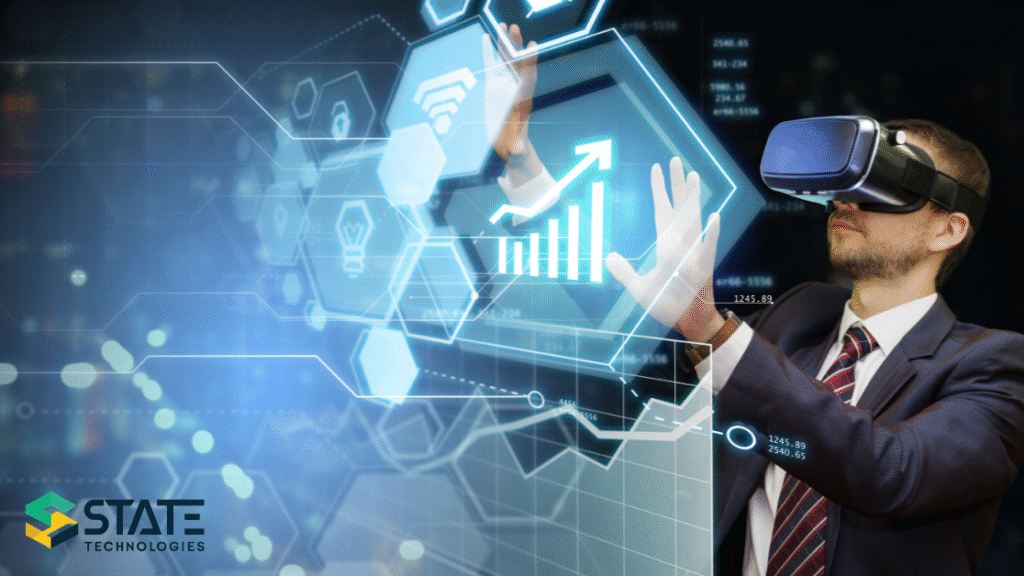
Virtual Reality refers to the use of a computer-generated environment that the user can explore using a Head-Mounted Display (VR headset). Users are completely isolated from the real world and are transported into a computer-generated world where they can walk, interact and perform various other actions.
Typical uses are:
2. Augmented Reality
AR enhances the visible world by overlaying digital images, text and animation on the real world using smart phones, tablets and smart glasses. It does not replace reality but complements it using digital overlays on the physical environment.
Examples of AR:
3. Mixed Reality
Mixed Reality-enabled environment in which the game documents are laid out in a physical space but are augmented by digital information and simulated objects and worlds—objects that work dynamically, flawlessly and naturally—interacting with each other and with the player’s real world environment. Unlike virtual reality (VR) and augmented reality (AR), digital objects respond to and interact with the physical environment.
Some applications include:
4. Extended Reality
Extended Reality is a generic term for:
XR is the generic term that encompasses all immersive experiences that are mediated by the digital and real worlds.
AI makes immersive technologies smart—making decisions, identifying objects, responding to voice commands, automatically adapting to you. AI can also make virtual worlds more natural in their responses to you.
Computer vision gives machines the ability to visually perceive and comprehend the physical world through the use of cameras and sensors. It recognizes faces, objects, hand gestures and environments, which makes it integral to AR and MR applications.
3D modeling involves the creation of lifelike 3-dimensional objects and environments. These digital models are what make up the virtual worlds of experiences in VR, AR and MR.
Spatial computing allows digital objects to sense the physical environment. By anchoring digital content in the real world, it creates more natural and compelling immersive experiences.
Motion tracking involves the use of sensors and cameras to identify the movement of the user’s head, hands, body or eyes. The user can then manipulate the virtual world using natural movement.
The third benefit is the processing power and storage provided by the Cloud. This permits handling complex immersive applications. It offers real time collaboration, improved rendering speed and the ability to access immersive experiences on multiple devices.
How Immersive Technologies Work
Immersive technologies consist of hardware and software that produce engaging digital activities. In general, it works as follows:
Why should businesses choose State Technologies for immersive technology services?
State Technologies offers tailor-made immersive technology solutions to address specific business requirements. Using an integrated approach with solutions combining VR, AR & MR technology, State Tech enables organizations to optimize staff training, maximize operational efficiencies, improve customer experience and expedite digital transformation through innovative and scalable solutions.
FAQs
1. What are immersive technologies?
Immersive technologies are those digital tools that simulate real or imaginary environments by blending the physical and digital worlds. They encompass Virtual Reality, Augmented Reality and Mixed Reality technologies.
2. What are the different types of immersive technologies?
The key types are Virtual Reality which generates an interactive 3D environment, Augmented Reality that overlays interactive digital elements upon real scenes, and Mixed Reality where digital and physical objects interact in real time.
3. Where are immersive technologies applied?
Immersive technologies find application in banking, finance, education, manufacturing, government, healthcare, retail, gaming, real estate, automotive, tourism, and staff training platforms to boost productivity and customer experience.
4. What advantage do immersive technologies provide?
They boost customer interaction, deliver effective training and education, facilitate remote team collaboration, diminish costs, and boost work output.
5. What technologies enable immersive experiences?
Immersive experiences derive from technological advances such as Artificial Intelligence, computer vision, 3D modeling, spatial computing, motion tracking, cloud computing, Internet of Things , sensors, cameras and rapid connectivity like 5G.
Conclusion
State Technologies aim to provide tailored immersive technology solutions fitting to their specific business requirements. Integrating technologies such as VR, AR and MR, they help companies with training, operations, customer engagement and digital transformation process to keep business future-proof through scalable solutions.