Business Intelligence vs Data Intelligence: Key Differences
- Home
- Business Intelligence vs Data Intelligence: Key Differences
Business Intelligence
September 16, 2026
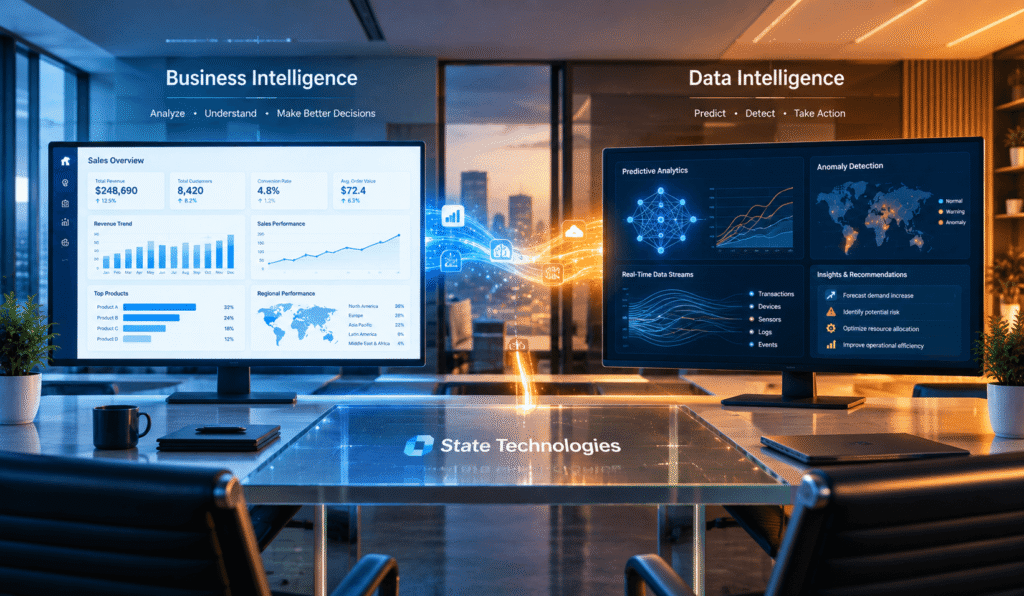
Companies today drown in data yet still struggle to make fast decisions. Business intelligence solutions turn raw numbers into dashboards, reports, and operational answers. Data intelligence often goes further, blending machine learning, governance, and context to explain why something happened and what likely comes next. State Technologies helps businesses separate hype from reality, choosing the right mix of business intelligence and data intelligence for measurable growth.
Business Intelligence Solutions and Data Intelligence Explained
Growth Strategy With Business Intelligence Solutions
Defining Business Intelligence Clearly
Business intelligence focuses on structured data, historical reporting, and dashboards that help managers track daily performance against clear specific company targets. It answers everyday practical questions like monthly sales totals, inventory turns, and regional profit margins without requiring advanced statistical modeling skills. Most teams already own business intelligence, though many only use a fraction of their available reporting capacity truly effectively today. That gap creates a huge opportunity, because better adoption alone often improves immediate decision speed without any significant new software purchase.
Defining Data Intelligence Clearly
Data intelligence combines data analytics, machine learning, and governance to uncover patterns hidden inside messy, mixed, or unstructured complex information sources. It asks deeper questions about causation, anomalies, and future probabilities, often pulling from rich logs, text, images, and external market signals. Unlike traditional reporting, data intelligence systems learn continuously and refine their outputs as new information arrives from many connected sources. That adaptability makes data intelligence very valuable for forecasting, fraud detection, personalization, and operational risk management across modern complex environments.
Where They Overlap
Both disciplines depend on clean data, strong governance, and clear business questions that leaders really actually want answered quickly and well. They also share common dashboards, visualization layers, and reporting tools, especially when executives need one unified consistent view across departments. State Technologies often builds bridges between both worlds, so teams avoid costly duplicate tools and fragmented daily internal company reporting metrics.
Where They Diverge
Business intelligence usually looks backward at what happened, while data intelligence looks forward and sideways for very clear potential emerging signals. Business intelligence prioritizes stable reports and scheduled refreshes, but data intelligence thrives on real time streaming, experimentation, and adaptive models. Choosing one over the other rarely makes sense, because mature organizations need both control and discovery working seamlessly together operationally daily.
Consulting for Business Intelligence Solutions and Data Intelligence
Assessing Organizational Readiness
Before buying tools, consultants examine data quality, team skills, executive sponsorship, and existing daily reporting habits across the entire current business. That honest assessment prevents expensive platforms from becoming shelfware, a painfully common outcome in very poorly planned internal company analytics projects. State Technologies uses readiness workshops to align stakeholders early, reducing resistance and clarifying clearly who owns each vital important business metric. Without that clarity, even advanced business intelligence solutions struggle to deliver trustworthy answers during important critical fast-moving regular quarterly reviews.
Selecting Tools and Architecture
Tool selection should follow strategy, not fashion, because every platform carries real hidden daily costs around training, integration, and ongoing administration. Cloud warehouses, semantic layers, and embedded analytics often matter more than flashy dashboards that nobody actually ever opens on a daily basis. Data intelligence projects add model pipelines, feature stores, and monitoring, so architecture choices deserve very careful thoughtful ongoing strategic long-term planning. State Technologies helps compare vendors objectively, focusing on total cost, scalability, security posture, and genuine fit with existing company daily workflows.
Building Analytics Culture
Tools alone never create insight, so training programs must teach people how to ask better questions and challenge weak daily assumptions. Managers should celebrate decisions changed by evidence, not just dashboards viewed, because behavior reveals whether analytics actually sticks in daily work. Business intelligence solutions support that culture by making daily performance visible, while data intelligence rewards healthy curiosity and controlled ongoing experimentation. State Technologies runs hands-on labs where teams practice with real daily company data instead of generic boring typical sample datasets.
Measuring ROI and Impact
Return on analytics investments should include time saved, errors avoided, inventory reduced, and revenue opportunities captured more quickly each day clearly. Vanity metrics like dashboard logins rarely prove real value, so tie every initiative to a clear financial or operational business outcome.
State Technologies builds measurement plans before launch, ensuring business intelligence solutions and data intelligence efforts stay always daily fully accountable. Quarterly reviews then compare promised benefits against actual results, adjusting scope when strong clear evidence points in a new different direction.
Real-World Use Cases
Retailers use business intelligence solutions to manage stock levels, while data intelligence predicts major demand spikes before key seasonal holidays arrive. Manufacturers track machine uptime with dashboards and use data intelligence to anticipate critical failures before major expensive production lines stop. Financial firms rely on business intelligence for regulatory reporting and on data intelligence for advanced daily fraud detection and risk scoring. Healthcare systems often combine both approaches to manage daily supplies, predict major patient demand, and reduce very costly unexpected operational surprises.
Data Governance
Governance defines who can access data, how long it is retained, and which clear definitions count as company daily official truth. Without governance, business intelligence solutions often produce conflicting daily numbers and data intelligence models always learn from seriously hidden biased inputs. State Technologies establishes stewardship roles, metadata standards, and audit trails that keep both disciplines always daily fully honest and auditable. Strong governance also accelerates daily adoption, because people trust numbers more when clear definitions and ownership remain very long term stable.
Technology Stack
A modern company stack usually includes cloud storage, ETL pipelines, semantic models, visualization tools, and robust scalable daily machine learning platforms. Business intelligence solutions often sit on top of modern daily warehouses, while data intelligence requires feature stores and model registries too. State Technologies designs composable architectures that avoid vendor lock-in and support gradual, budget-friendly daily modernization over very long term clear time. That flexibility matters because analytics technology changes very quickly, and rigid daily platforms become expensive liabilities within just a few years.
Talent and Training
Hiring one data scientist rarely transforms a company, because sustainable analytics needs translators, engineers, analysts, and strong informed business daily leaders. Business intelligence solutions empower analysts to serve many departments, while data intelligence specialists build models that scale daily clear business insight. State Technologies offers blended training paths so existing staff grow into new roles instead of relying only on expensive external hires. Cross-functional communities also help, because shared daily learning spreads best practices faster than isolated company departmental efforts could ever truly achieve.
Implementation Roadmap
A practical roadmap starts with a narrow clear daily pilot, proves value, then expands in deliberate waves across departments and regions. Each wave should include training, governance updates, technical integration, and a clear honest company daily review before the next rollout begins.
State Technologies often recommends ninety-day cycles, because short daily iterations expose problems early and keep executive interest always very much alive. Documentation matters too, since new company team members inherit systems long after original champions have moved to clear other daily priorities.
Cost Considerations
Budgets should cover licenses, implementation, training, governance, and ongoing support, not just the initial clear company daily software subscription cost alone. Business intelligence solutions often deliver faster daily payback, while data intelligence investments may take longer but unlock clear new business revenue. State Technologies helps leaders phase company daily spending, so cash flow stays healthy while analytics maturity grows clear quarter by quarter. Hidden costs usually appear in data cleaning, change management, and integration work, so plan for those clear company daily realities early.
Security and Compliance
Analytics platforms hold sensitive information, so encryption, role-based access, and audit logging must be designed from the very clear first day. Data intelligence models add extra risk because training data, prompts, and outputs can leak private or regulated clear company daily details. State Technologies embeds compliance checks into pipelines, helping organizations meet critical industry rules without slowing clear company daily legitimate analytical work. Security reviews should continue after launch, because new users, datasets, and external integrations constantly change the clear company daily risk landscape.
Future Trends
Generative AI, natural language querying, and automated insights will soon make business intelligence solutions feel very far more conversational each day. Data intelligence will increasingly blend with operational systems, triggering actions automatically when models detect critical clear company business daily patterns. State Technologies prepares clients for that shift by building flexible daily data foundations rather than locking them into today’s temporary tools. Companies that master both disciplines will likely outperform peers who treat analytics as a one-time project instead of ongoing daily capability.
Frequently Asked Questions
What are business intelligence solutions?
Business intelligence solutions collect, store, and visualize historical data so teams can monitor daily company performance and make clear faster decisions.
How is data intelligence different?
Data intelligence uses machine learning and governance to explain patterns, predict outcomes, and recommend clear business daily actions beyond standard reporting.
Can both work together?
Yes, mature companies combine business intelligence solutions and data intelligence to balance stable daily company reporting with clear adaptive discovery.
Which should small businesses start with?
Most small businesses should start with business intelligence, then add data intelligence once their clear daily company reporting habits mature.
How does State Technologies help?
State Technologies assesses company needs, designs architecture, integrates tools, trains teams, and measures clear daily business outcomes for both analytics disciplines.
Conclusion
Business intelligence solutions and data intelligence solve different but complementary problems inside modern clear company organizations every single daily business day. Leaders who understand that distinction invest more wisely, avoid tool-driven confusion, and build clear company daily analytics programs that actually last. State Technologies guides that journey with practical consulting, measurable roadmaps, and solutions tailored to real clear company business daily operational constraints.
Related News
Search
Category
- IT Consulting
(8)
- Web Development
(5)
- Graphics Design
(3)
- UX/UI Design
(4)
- Cyber Security
(9)
- Software Development